

THE CRAFT OF WRITING — SEPTEMBER 2021
The Plot Whisperer
“Why is writing important? Because it teaches you about yourself, expands your horizons, and challenges you to discover new truths.”
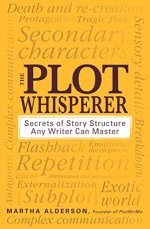
That is the very first paragraph of Chapter One in Martha Alderson’s book The Plot Whisperer.
If you’re like me, you’re probably nodding your head up and down in eager agreement because those two sentences resonate with what you’ve discovered about yourself as a writer.
Once I began reading The Plot Whisperer, I knew I wanted to explore more of what Martha Alderson had to say about writing, so it is with great pleasure that I welcome Martha as my guest today on the Craft of Writing blog.

***


Martha Alderson, MA, is the author of the bestselling The Plot Whisperer. She writes novels for readers, plots books for writers, and most recently a workbook for anyone looking to enrich their lives with more creativity and inspiration. Martha has been exploring and writing about the Universal Story for the past twenty years as part of the plot support she offers to writers. She first introduced the Universal Story in The Plot Whisperer to transform writers’ creative lives and to “show” plot. More recently, she has expanded her work to include helping people transform their creative lives.
TWEETABLE:
THE PLOT WHISPERER with Martha Alderson Share on X
***
Welcome to the Craft of Writing blog, Martha Alderson. Thank you for joining us!
Thank you for inviting me and for the opportunity to share my passion with your followers.
Tell us about your writing journey. Why did you decide to write books on the craft of writing?
I started writing fiction on a lark after having sold my speech, language, and learning disability clinic for children. Quickly, I stumbled over plot. As I analyzed literally hundreds of novels, memoirs, and screenplays for plot, I started sharing what I was learning with my writing friends. That quickly led to a writing gig at the University of California Santa Cruz. This was all long ago when plot wasn’t something covered in creative writing classes. Now, there are loads of books on plot but that wasn’t the case back then. Find a need and fill it. I independently published my first book on plot that’s now published by Penguin Random House as Writing Blockbuster Plots. Quite a thrill indeed! From that first plot book evolved my bestselling The Plot Whisperer book.
In The Plot Whisperer, you talk about the Universal Story. Can you define what you mean by that?
The Universal Story is an energetic pathway that is at the heart of every great transformational journey in stories and in life. An understanding of the Universal Story helps you better direct the flow of your story and connect you to your creative promise.
I noticed in your book that you describe two approaches to writing: the left-brain, analytical approach and the right-brain, intuitive approach. Can you describe each of these? Do they present different challenges for the author?
Plot is a linear, organized sequence of events affected by cause and effect. Thanks to my background in special education, I appreciate that we all learn differently. The longer I taught plot, the more clearly emerged two major types of writers. Some writers quickly pick up the concept of plot. Others struggle and feel stifled. For ease, I divide the two groups into left-brain, analytical and right-brain, intuitive. Those who grasp plot easily – left-brain dominant versus those who don’t – right-brain dominant.
Can you explain what a Plot Planner is and why it helps define the overall plot?
The Plot Planner replicates the energy of Universal Story and highlights the essential Energetic Markers in every great story. Creating a Plot Planner for your story allows you to step away from all the words and “see” your plot from beginning to end. It allows you to evaluate the sequence of your scene placement and the cause and effect at play.
Why is it important to develop a Scene Tracker when writing a novel?
A Scene Tracker allows you to analyze your scenes based on the 7 essential elements in every great scene.
How important is it for the novelist to show transformation in the main character?
If all the drama and excitement, conflict and suspense, mystery and romance in your story doesn’t affect your protagonist on a deep emotional level, what’s the point of your story? In other words, characters grow and change because of what happens from the beginning to the end of your story.
What one piece of advice would you give to new writers?
Understand that writing a novel from beginning to end takes you on an epic journey. You’ll learn as much about yourself as you do about stories the longer you write. Keep going. Trust the process.
Where can we find out more about you and your work?
@MarthaAlderson (FB)
@MarthaSAlderson (Instagram)
@PlotWhisperer (FB, Twitter, Instagram)
Thank you, Martha, for being with us today.
You’re more than welcome, Kay!
THE PLOT WHISPERER with Martha Alderson Share on X